How can you be your own PR spokesperson?

Photo by Lukas on Pexels.com

By Emma Stevens

According to Caroline Forsey’s blog, PR is, “..professional work with an organization, company, government, or individual to cultivate a story that portrays that client’s reputation, idea, product, position, or accomplishment in a positive light.” So how can you take this definition and apply it to your personal life? I’ll tell you with a quick how-to guide about being mindful of your public relations. 

First, I want you to consider what your values are. I value connection, relationships, health and hard work. Now, I want you to take your values and make a promise to yourself, just as you would for a company you are working for. For example, I promised myself that I will continue to make connections, build relationships, stay healthy and work hard. My values have become a part of my brand. 

Second, consider what your story is and how YOU want to tell it. Your story is what makes you unique, so use it. I have been applying to internships recently, and one of the first questions I get during an interview is, “tell me a little bit about yourself.” This is where your narrative can shine. Additionally, telling a story goes hand-in-hand with drafting future cover letters, resumes, portfolios and interviews. I just got an interview for my dream PR firm because I wove my story into their company’s brand story. Explain how your skills would fit and how you obtained the skills you have. We all have something that makes us a special candidate, so take control of it and write about it. 

Third, Reputation is a huge part of PR, and you can use the same skills for your personal life and brand. I think reputation is related to values, how you present yourself in the world, the voice you choose and your social media presence. As a PR professional, I hope to uphold my professionalism, brand, and skillsets. This can be done by having a consistent narrative, being mindful of what you post, being socially aware and knowing your brand. 

Lastly, write about your accomplishments! You worked hard for everything you’ve accomplished, so highlight that. Maybe you mastered Cision for the first time… post about it on LinkedIn or add it to your resume. Your accomplishments are part of your story; you did amazing work and were recognized for it. Go YOU! 

In conclusion, the definition of PR represents everything above with a positive light. You are your PR boss and that is something to be proud of! Let it SHINE.
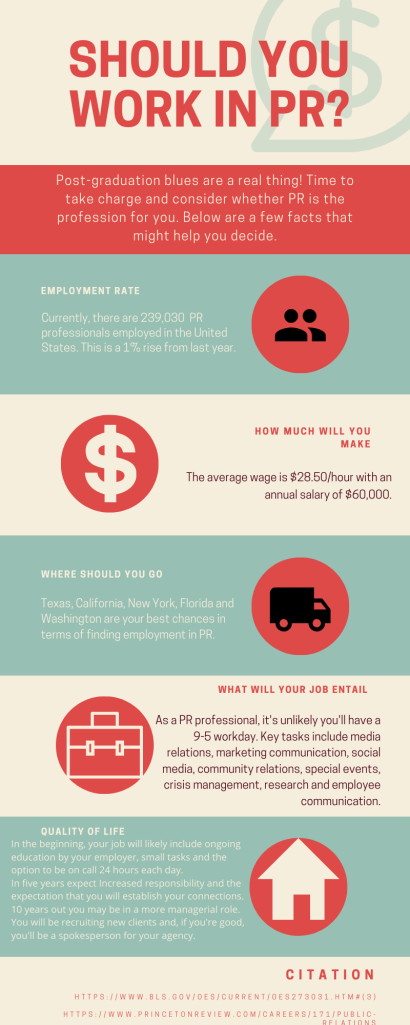

The process of creating a good infographic

By Emma Stevens

Infographics are not only a great PR tool but also an effective way to spread information. I recently created an infographic for one of my classes at the University of Oregon and I wanted to share my process. 

The first step for creating a good infographic is considering the story you want to tell. It took me a while to figure this out, and I even reached out to my teacher for some input. In my rough draft, I ended up spilling out PR facts that did not correlate, nor did they form an interesting story. It is important to remember that an infographic is not just data, but rather an engaging visual that gives your information a backbone. I decided, after getting some great tips from my teacher, that I would help my readers decide if PR was the job for them. 

The second step was considering what data was relevant and valid. I used Google and typed in a few keywords: PR, PR employment rate, PR work-life culture. I filtered through multiple types of sources and chose to focus on government and well-respected news sources. Infographics are data and tend to not be opinion-based, I would suggest steering away from blog posts or random articles for your data or facts. 

The third step was picking the best data. I used the government source as my top data, focusing on the employment rate and the best cities for getting a PR job. I thought these worked well together and gave insight into the job market and PR’s global scope. I then used a source that gave my readers facts regarding work-life culture and the critical tools you will be asked to use. I believe the infographic flowed nicely and gave readers both data and facts that would be helpful for post-graduation or any type of job searching. 

The fourth step was creating a visually appealing infographic. I used Canva, which is a great website for creating creative content. I used a free template and added my graphics and data. I chose to focus on one color scheme with neutral but bright colors. I alternated font colors and added a descriptive title to help my reader understand the story I was trying to tell. Additionally, I focused on making sure it was organized and that the infographic was simple. Finally, I made sure all my fonts were the same size and my text was in line with each other so that the reader’s eyes could easily follow the information. 

Ultimately, my goal was to help anyone in the job market consider whether PR is the job for them. I wanted to tell a story and highlight my passion for the PR industry. Take a look for yourself.

Should You be Tracking Trends?

Photo by Tracy Le Blanc on Pexels.com

By Emma Stevens


Tracking trends for your industry is a critical part of doing good PR work. Just recently I posted about upcoming trends in biking for my client, PeaceHealth Rides. Through this, I realized the importance of staying on trend and always being aware of what is happening in your industry. 

For my blog, I started with a basic search: “what are the trends in biking for 2020.” I started on the first page and scrolled through multiple articles, company’s news releases and similar blog posts. This is defined as secondary research: using outside information to further your knowledge and overall point of focus. The important element to consider when completing secondary research is whether your source is valid. When I was researching bike trends I focused on published articles in reputable journals, successful business and blogs that had large followings and a loyal fan base. 

To make your research easier, consider using keywords that are common to the industry your client is involved with. For example, I used trends+biking+2020+upcoming as my keywords. This created a narrower and more specific search and fewer sources to sift through. 

The question is, what should you do with the research? Trend tracking is useful for creating social content, listening to your audience, scoping out what your competitors are doing and writing a blog post or news release highlighting the company for which you are working. 

Public relations is about finding your clients’ stories and telling them in the best way possible. Trend tracking helps you keep your posts up-to-date and relevant. Furthermore, it gives you a “big picture” outlook on your industry’s future. Finally, it’s interesting – it keeps me interested, which is how I want to be when I’m working for someone. I have no interest in doing the same things over and over again – I like fresh and new and compelling. This is what you get when you do your research.

I turned this renewed interest into a blog post on bike trends, thereby inspiring my audience and supporting my company’s key message regarding sustainability. Also, using trendsetter helped me understand what companies I should be looking at, possible partnerships and potential spokespersons/influencers. If you are inspired by a trend you see, investigate it and use it to help tell your story. 

I noticed that e-bikes are an upcoming trend, so I researched e-bike companies, spokespersons and influencers. I decided that at this time we do not have a market within this trend, but it could be a great source for networking, collaboration and creative content for PeaceHealth Rides. 

Finally, always consider the trends that are falling away, and make sure you are not one of them. If you start seeing patterns that indicate that you are on the outs with your industry’s trends, it’s time to do some secondary research.

How to Handle Public Panic With Public Relations

Photo by Andrea Piacquadio on Pexels.com

By Emma Stevens

Social media has forever changed the way crisis PR works. Media is constant and information spreads like wildfire. For PR professionals it can feel like you will never keep or catch up, especially when a crisis occurs. Most recently, a good example of social media that created chaos is the coronavirus outbreak. Articles, tweets, snap stories and Instagram posts flood us all with news, sometimes incorrect and targeted information. Social media allows all of us to be the “experts” on all things corona. This is detrimental for everyone concerned, and exactly why we have PR professionals to try to contain  misinformation and spread helpful information. So how do we do this? 

The first thing to consider is what the key message is for the crisis. As a professional, you should dig for the correct information and distribute only this. Second, use simple language that can’t be easily misunderstood or spread incorrectly. In the case of the coronavirus, some PR professionals are ignoring the science and statistics that can be easily obtained from the World Health Organization’s (WHO) very up-to-date website, in favor of news outlets that use inflammatory headlines that pull in readers at the expense of accurate information. This is not integrous and doesn’t do readers or the health care professionals who are in the thick of things any favors.

When it comes to crisis PR, constant communication is key. Even if you don’t have all the information it is still necessary to get ahead of the false information and hysteria. All of us should have go-to resources we can depend on for good information, such as WHO, BBC News, Forbes, etc. It is our responsibility to know where we can go for the “real” news so that what we’re posting about is honest and accurate.

Additionally, consider your audience and where they tend to go for news. Much of young people’s news comes from social media, so carefully consider how you will override and/or discredit invalid or out-of-context information. According to Gil Bashe, managing partner of global health at Finn Partner, “In the absence of an authoritative source, a void is created and people fill the void with what they think.” What a layperson is thinking is often rooted in the fear promoted by false news outlets. A person without any background knowledge in viruses, who is on a 24-hour news cycle that she or he is not checking for accuracy, may go to the worst-case scenarios. According to a study done by MIT, fake news is “70% more likely to be retweeted than true stories,” in large part because it’s more “thrilling.” Be the professional who figures out how to spread accurate information in such a way that your audience comes to you rather than your competitor.

Finally, I want to highlight the importance of PR being a human interest job. Currently, people are using sources like Snapchat news and quick stories to point out possible patient zeros. People’s lives are being forever ruined by a single snapshot. As a PR professional this would be one of my top priorities for regulation. In the case of a virus, it is critical to reinforce the true cause and deter people from targeting and pointing fingers.

Informational Interviews are Necessary!

By Emma Stevens

Photo by mentatdgt on Pexels.com

As you begin your career as a PR professional, you will most likely participate in many informational interviews. Daily phone calls and coffee dates may seem tedious but they are a crucial element for the networking you will need to do both as part as your job, as well as when scouting for future career opportunities.

Here is a list of the best ways to conduct and prepare for an informational interview

  1. Research: Research is a critical component of adequate preparation. For example, I had an informational interview this Tuesday.  The night before I looked at the company’s website, socials, team and clients. I researched the person I was meeting with and dived into her background and career history. Research is what helps you construct good questions, find points of similarity and a way to highlight your work. For example, the main theme of this company’s website is collaboration and teamwork. I was able to connect the goal of the company to work I am doing as a team member of Allen Hall PR. Additionally, they work closely with the community at large, which I was able to connect with because I am a local in their target community. I developed talking points, questions, practiced my tone of voice and figured out which of my skills to highlight all from research conducted in less than an hour. Take the time, put in the work and get the most out of the interview. 
  2. Come prepared: I understand it is easy to take informational interviews less seriously than a “real” job interview, but I would urge you not to do this. Every informational interview is critical for career-building and networking opportunities. Additionally, the person you are speaking to is taking time out of their day and work schedule, so don’t waste their time. On Tuesday I was able to learn about how to construct a PR agency from the ground up. This is amazing information and something I most likely would not learn day-to-day or in my classes. 
  3. Be yourself: It is easy to feel intimidated by professionals, especially if they are in a position of authority. I urge you to remember that they are just people like you or me. Furthermore, they agreed to take time to talk to you, which means they saw something in you they believed in. You are learning from them, but that does not mean you shouldn’t highlight your skills or relate yourself to them professionally. 
  4. Don’t ramble or interrupt: Informational interviews tend to be short and to the point. Make sure you ask direct questions and allow the person to answer fully before moving on. Also, let the conversation unfold naturally. If your interviewer wants to focus on one question the whole time and you are learning a lot from it do not feel pressured to move on to the next question. This is your time to showcase your professionalism, work ethic and professional tone in the conversation. 
  5. Network: This is your time to build relationships. Make sure you remind your interviewer of your name and constantly showcase yourself and brand. If it is appropriate, you can consider asking if they have additional contacts you could reach out to. 
  6. Thank you: This is the most important part. Always follow up with a thank-you email (or handwritten card) immediately. Additionally, thank them when you arrive and again when you leave. A follow up email can also allow you to reach out and ask for further contacts or internship opportunities.

Self-Branding

By Emma Stevens

Photo by Kaboompics .com on Pexels.com

Most of us are under the delusion that we have ourselves pretty figured out. I sure did, until I was asked to consider what my brand was as a PR professional. I was stumped, what is my brand? How do I want to present myself in today’s mashup of technology, social media and professionalism? This is a complicated relationship, one I believe should be considered wisely and thoughtfully. 

So let’s think about it. What is self-branding and how can I accomplish this critical piece of my professional palette? My professor blank gave us a good definition of what self-branding is, and I’d like to share it with you. 

The personal brand combines: 

1. The look, feel and content you use to portray yourself.

2. The promises people can count on you to uphold.

In other words, consider how you will portray yourself to the world and what you can REALISTICALLY do for the company/organization for which you are working. This is completely in your control. 

I started my self-branding journey with a personal bio. This may sound simple, but trust me, it is not. Imagine trying to describe yourself, all of your experiences, and what makes you unique in 300 words. IMPOSSIBLE. It took me hours to come up with something I was happy with, and this is what I learned:

  1. Start with an outline of the most important things to and about you.
  2. Carefully consider how you want to present yourself in your introduction, as well as the tone you will be using. KEY: The tone of your personal bio should adhere to your brand. 
  3. Write it out, edit later. 
  4. Find a balance between approachable and professional language. 
  5. Focus on key things that relate to your profession. For example, I focused primarily on my PR experience. 
  6. Keep it light and short.

You have now gotten over the first hurdle of your personal branding journey. Take a break, rehydrate, grab a snack and get ready for the next one. Resumes and cover letters. 

Resumes and cover letters are sneaky difficult. Both take a lot of time and consideration. I revised my entire resume over winter break and it was exhausting. Here is what I learned.

  1. Consider your dream job and construct your resume around that job.
  2. Pick out key facts, experiences and accomplishments that promote your self-branding and professional future.
  3. Use short, clear sentences. 
  4. Decide whether you are writing in the past or present. I messed this one up once or twice – well, honestly, many times. 
  5. Pick a font and stick with it.
  6. Organize with headings. 
  7. White spaces are your friend. 
  8. Pick a font and layout that, you guessed it, adheres to your brand.

Whoo! That was a lot, but sadly your journey should not stop there. The next step consists of our dear friend, SOCIAL MEDIA. Social media may seem simple, but when it comes to self-branding, it gets more complicated. Here is what I thought about when branding my social accounts.

  1. What kind of language is best received on each platform? 
  2. How quirky did I really wanna be? 
  3. Who am I as a professional and what does that look like visually? This is particularly true for Instagram. 
  4. What content did I want to promote? For this tip, I would consider your dream job and find content that aligns with a future career possibility. 
  5. Make it colorful and fun. Just because your socials should be professional does not mean they should be boring.
  6. Be consistent. Once you pick a brand, stick with it. 

Alright! Way to go. I promise this is the last step. The last thing you should consider is how you will promote your new professional brand. My advice is NETWORK! Networking is key and should be constantly on your to-do list as a professional. Here is what I learned about networking 

  1. Think about your dream job and find people who are in a similar position. 
  2. Use LinkedIn and Twitter. Both of these social accounts have great direct messaging services.
  3. If you see someone doing something that inspires you, reach out to them.
  4. Constantly put yourself out there. You might not always get a response but at least you are trying. And who knows, down the line, someone might remember your name.
  5. Think big. No one is unreachable nowadays. Reach out to anyone who inspires you and ask them how they got there. Even Obama answered emails when he had time, and you never know when you might be that one person someone takes the time to connect with.

In-House versus Agency

Photo by Burst on Pexels.com

By Emma Stevens

As I get closer and closer to graduation, I have to make the ultimate decision between working in-house or for an agency. For those of you who read my blog and don’t know PR lingo, I will give a quick summary. 

In-house means you work for a single organization as part of its PR team. This tends to give you less independence, and you work solely for a single entity. An example of this would be working for Coca-Cola Co. in its communications branch.  If you work for an agency, you represent that agency and work with all of its clients. An example of this is Edelman, currently the number one agency in PR. Edelman has a variety of clients, including Samsung, Microsoft, etc, for which the team works.

 How does one decide this potentially life-altering decision?! I always thought I wanted to work for an agency because of their flashy names and “exciting work,” but as I get closer and closer to the big decision, I am more critical of my earlier opinion. So to help me out, and hopefully, you guys as well, let’s make a pros and cons list. Fingers crossed we can decide after this. 

Unfortunately, I do not have experience with either so I think I need some help from our dear friend PR Weekly to decide. It has a great article on its website that gives us a chance to listen to both sides of the argument. Put on your robes, judges, and let’s hear the “great debate.”

PR Weekly asks us first to think about “breadth” versus “depth.”  

In other words, if you work for an agency you will have a variety of work, which means learning a bunch of new things. Take our Edelman example–as part of its PR team you would be responsible for working on a campaign for the new Samsung Galaxy, at the same time working on crisis control and a press release conference for Microsoft, and it’s blowing up your computer! Just kidding. To me, this screams a lot of work, but also the opportunity to use, and learn, a variety of skill sets. Agencies seem to be a great starting point for building a solid portfolio of work experience. 

In-house gets you down to the bones of a company. Your company becomes, for lack of a better expression, “your baby.” If  you work for Coca-Cola Co., you will mostly become an expert on fizzy drinks and the various ways to market them. To me, this feels more personal and also less of a risk. You can focus on getting to know one thing very well, and have the chance to explore all the various ways to enhance the one brand.

PR Weekly also calls attention to the importance of professional development

This grabbed my attention. I am a fresh face in PR and I am constantly trying to grow myself as a professional. The question is, where can I do this best? PR Weekly advises that “agency employees are thrown into the proverbial ‘deep-end.’ On-the-job learning takes place in a fast-paced environment and there are regular opportunities to get hands-on experience with something new.” This seems intimidating, but also full of new opportunities and experience. You know what they say: “You’ll never know unless you jump right in.” 

In-house tends to be slower-paced but is still incredibly valuable. You will most likely work with multiple people on a single project for your company. Although this might seem, from the outside, to be less exciting, I have heard the reward for your work is more easily recognized and valued. 

The last thing PR Weekly touches on is culture. This is a critical part of the decision for me. There is a significant difference between older, more traditional organizational culture, and the new. According to PR Weekly, Agencies tend to be fast-paced, high energy and creative. In contrast, in-house is more traditional PR work, but also incredibly personal and detailed. 

I got first-hand experience with the culture of a large agency when I applied for an internship with Ketchum. I was required to come up with a creative campaign and a social media plan. I had two days to do so and, once completed, I was competing with fellow PR college students. The energy was high and the competition was fierce. 

After hearing both sides, I have declared, as the judge of this monumental life decision, that it’s a tie. I simply don’t have enough experience to make this decision as of yet. This is where my summer internship will come in, for sure. That said, it also became clear during this “trial” that my ultimate decision is in large part determined by my personality and skill sets.

 Let me know in the comments below what your ultimate decision was, and why. We have to work together on this! 

Can You be Both a Social Activist and a PR professional?

Photo by Sides Imagery on Pexels.com

By Emma Stevens

The PR profession is often criticized for being disingenuous, and all you have to do is take be brief look at the media to see that this is often true. That said,  I believe that anyone can do just about any job in a dishonestly and that it’s up to us to live our lives with integrity and authenticity. From my point of view, understanding  the scope of the world and how your company fits into trends, news and activism is a key part of PR. Additionally, as our country has become increasingly divided, the public wants to know their favorite brands share their values. The important thing to consider, if you are thinking of taking on a political issue, is the backlash. Be extremely mindful and authentic when deciding your “social battle.”

Here are some companies I believe have done a great job at this 

  1. Dove

Dove is a brand that sets its eyes on changing how we advertise to women and men. Dove’s main goal was to promote the real bodies of women of all shapes and sizes. The company used its brand and voice to fight against unrealistic beauty standards with over a hundred separate campaigns. Dove has also learned from its mistakes. For example, the company was criticized for using the new message solely for profits. In response, Dove has created more and more authentic content, all the while partnering with pro-women organizations. If you can find an organization that aligns with your company’s key messages, endorse it. Loyalty to a brand is earned through that brand’s on-the-ground actions. Show your support of non-profits or any organization that aligns with your campaign in an authentically.

2.  Nike 

I referenced this in another blog, but Nike took a risk and promoted Colin Kaepernick, who has been publicly criticized for kneeling during the Pledge of Allegiance. Nike decided to feature him because they believed in him as an athlete, but also because he took a stand. Nike never openly stated that they agreed with his actions, but they supported him during a time when many were scared to do so. Nike is a huge brand with a wide variety of consumers, and they understood they could risk a backlash by taking up Kaepernick’s stance. And it did. Nike was criticized for promoting a “liberal” point of view for profit. I believe Nike wanted to represent its brand as one that accepts all people and all views. Nike chose to highlight what they preach and I don’t see any part of it being as disingenuous. 

3. Patagonia 

Patagonia is incredibly open about its views on climate change, our current president, immigration and many other hot political topics right now. It often uses its Instagram account to call out legislation that fails to protect our natural resources and by supporting political candidates with a strong environmental record.. A great example of this was a post from December: “… @u.s.forestservice is recommending to exempt Alaska’s Tongass National Forest from the Rule, which would open up this pristine landscape to logging, road-building and other development. We have a chance to do something about it. Make your voice heard with the @wildernesssociety by December 17th through the link in bio.” I believe this post is very on-brand. Patagonia is an outdoor company with a liberal CEO, and has always walked its talk. It has always had the same voice, views and scope of interest–protect the environment at all costs.

Now for the fun part, a company that missed the mark. Who remembers the famous Pepsi campaign featuring Kendall Jenner? The campaign showed Jenner casually joining a protest march to give the police a Pepsi as a “peace offering.” This campaign was met with enormous backlash, scornful memes and very PUBLIC scrutiny. Both Jenner and Pepsi apologized, but the ad still comes up in conversation today. Pepsi was accused of appropriating a protest movement to sell its product, thereby undercutting the march’s importance. Any brand that attempts to take on a political issue should take a page out of Patagonia’s and Dove’s playbooks – speak authentically to your audience, don’t trivialize what’s very important to a group of people.

My last piece of advice is if you are going to hop on a social or political trend, stay true to its message and follow through with your commitment. There is nothing worse than a company that jumps at any chance to be promoted. Keep your values intact and promote your message with the best resources you have. Don’t forget about your audience.

How to Handle PR During a Time of Tragedy

By Emma Stevens

Death is a very sensitive issue and should never be taken lightly. This last week basketball legend, Kobe Bryant, died in a helicopter crash. As the University of Oregon’s Senior Instructor, Kelli Mattews, posted on her social media accounts, “Free social media advice: if you’re managing a brand’s social media, turn off your promos and scheduled content today. People mourn, media help us process and understand. Brands need to shut up.” This is a good reminder, for agencies and PR professionals who have pre-written posts scheduled, to put social media on the backburner. 

Further, I want to consider the best approach for PR professionals to take during a time of tragedy. My first tip is to remember that PR’s core value is humanity. You should never forget your ethics as a PR professional, especially in times of crisis. TMZ released the information regarding Bryant’s death before the family was notified by emergency personnel. This is unconscionable. The ethics here are not complicated – no one wants to find out their loved one has died by seeing it on the news. Thankfully, TMZ has been widely chastised for their behavior, but the damage was already done. In my opinion, TMZ’s PR team made an error that won’t be soon forgotten. As PR professionals we must always consider how the information we’re putting out to the world will be received, and by whom. It is not our job to hurt people unnecessarily in the name of getting publicity.

Additionally, I would be mindful of what you post a tragedy has occurred. I noticed that multiple companies posted beautiful tributes to Kobe Bryan, followed almost immediately by a product endorsement. It’s not hard for the audience to figure out that the tribute was made in large part to promote a product, which means you’ve undermined your original message.

Further, I want to highlight Vanessa Bryant’s response to the tragedy. I am sure she worked with a PR team to post her statement and I believe it was done beautifully. Bryant’s PR team gave the family time to grieve and process the tragedy that occurred. Also, the PR team helped construct a statement that addressed the family’s grief and loss while also promoting and supporting Kobe’s legacy, MambaSportFoundation.org and a GoFundMe for the families affected. This felt extremely appropriate and well-constructed. It exemplified the basics of PR crisis work: address the situation and lay out what will be done to recover from it. 

Side note: I work for PeaceHealth running the company’s Twitter account. I decided to not post a tribute because it was not within my brand’s scope. This is okay. Additionally, I did not schedule or post any content for that day. Instead, I focused on my community and our basketball team, both of which were grieving Bryant’s loss openly. I engaged with the team’s content and showed my support. This felt both authentic and appropriate.

What Does 2020 Have to Offer for PR?

By: Emma Stevens

Photo by cottonbro on Pexels.com

PR Daily recently posted an article titled “2020 vision: The top 5 emerging trends in marketing and PR.” I personally believe that to better understand what’s happening in PR, you should explore many people’s ideas of what those trends may be. So…here is my take on the PR trends predicted for this year.

According to PR Daily, digital marketing is going to dominate in 2020. We are currently in the age of an interactive content explosion. In other words, companies should put their money into digital marketing. Vogue Magazine has done a terrific job at this. I was able to listen to talks by Michael MacLeod and Christine Banawa, who are both part of Vogue’s audience team. They were hired to revamp Vogue’s digital footprint. Vogue now uses snapchat to record backstage activity during fashion week, interviews with celebrities, links to articles, etc. As I stated in my earlier blog post, Snapchat and Vogue’s international Instagram accounts, run by MacLeod and Banawa, focus on a new way of storytelling and consumers love it. Make your stories digital. 

The second trend emphasises “chatbots.” Honestly, when I see the phrase “chatbots,” all I can think about is robots taking over. And I guess, in a sense, it’s true. Even when I clicked on SpinSucks a little robot popped up and asked me what I was doing there. Really?! Chatbots are supposed to be relationship builders, a way to interact with a customer who comes onto your website. If your robot is the right match and asks the right questions, you can learn what consumers want from you as a company. In other words, insert a robot and fish for the information you want to better connect with your audience. SpinSucks says this kind of AI, isn’t just a trend, “it’s a new reality.” So it looks like we will be talking to robots more, like it or not.

The third trend is “A social media influencer shapeup.” If you read my last blog, you know my personal opinion on influencers. The article PR Weekly somewhat agrees with me by stating, “consumers are no longer buying into influencers who rep brands that are not authentic to them.” Put differently, as a company you should consider carefully screening your influencers’ socials and reputation. Make sure they can do their job well while upholding the values of your company and your consumers. According to data accumulated by SpinSucks, politics really matter to most consumers, as do ethics. We have a very, very important election coming up. Although Twitter has said it will not allow political ads, Facebook is holding firm. Social media influencers will likely become even more important as the election heats up – it will be interesting to see how it’s used to gain and maintain audiences.

The fourth trend calls attention to “Brandstanding,” which is a new word for me. According to PR Weekly, “studies show that consumers feel a strong connection and are more loyal to companies willing to take a position on major issues and less to those who stay out of the fray.” Sprout Social released a survey indicating that two-thirds of consumers say, “it’s important for brands to take a stand on social or political issues.” A great example of brandstanding is Nike’s campaign featuring Colin Kaepernick. The ad spread like wildfire, with incredibly strong reactions going both ways. Some people burned their Nike shoes, while other people were celebrating Nike for making a stand. Regardless, Nike got a LOT of attention, which is what they hope for. Nike took a big risk,but it paid off. Not only did Nike get internationally recognized, the company’s sales skyrocketed. I like the notion: brandstanding. Definitely something I can get behind. 

Finally: “personalized brand experience.” In short, let technology take over. This means using algorithms to generate ads and content for consumers based on searches, demographics and social media behavior. Be sure not to overdo it, and implement it only for the right reasons. As PR Weekly states, “when executed correctly, new technologies will produce highly accurate customized recommendations.” AI again, this time in the form of algorithms that track our every digital step. While it might freak some of us out, ultimately it makes shopping much easier and that absolutely benefits brands. The other day, I wrote a paper that included the name of a book I’d read. By afternoon I was getting ads from Amazon that featured the same book. No, I wasn’t interested in that book anymore, but if it had been workout clothes…? No denying this kind of targeted marketing is very, very effective.

Thank you for reading my review of, and opinions about, current PR tendencies. Feel free to explore more PR trends – it’s going to be an exciting new year!

Design a site like this with WordPress.com
Get started